

📈 Buffett's $30B Google Bet
The Oracle breaks his silence, Warsh tightens his lips, and the auto-credit cracks spread.

Good Morning.
The thread connecting this morning’s stories is conviction under pressure: Buffett quietly building a $30 billion Google position while everyone assumed it was Abel’s call, Warsh holding the line on inflation credibility even as CPI and PPI print cooler than expected, and America’s Car-Mart collapsing under the weight of a consumer credit cycle that has quietly turned.
Capital allocation decisions made years ago are landing right now, and the consequences are hard to ignore.
1. The Lead · Markets
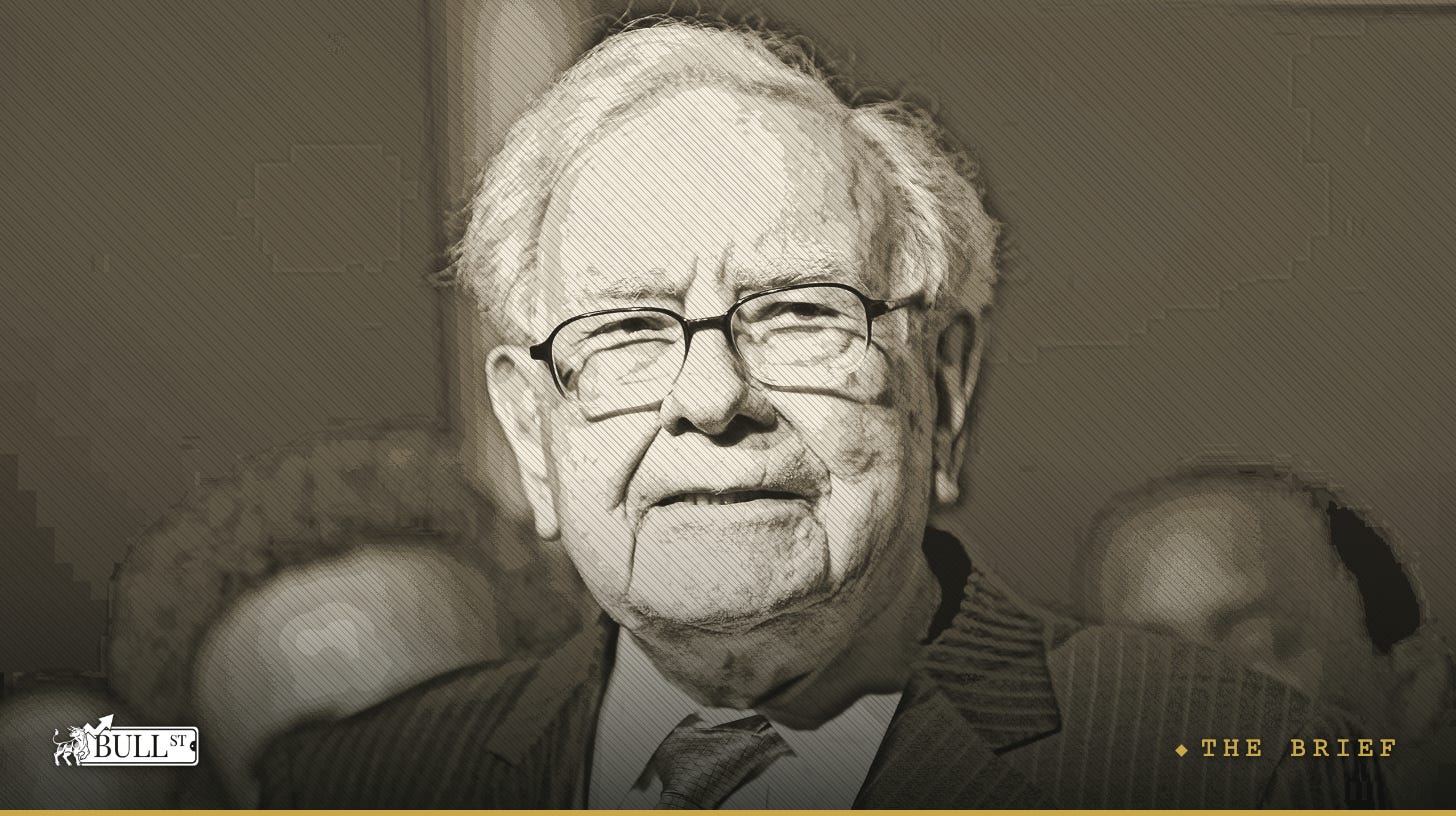
Buffett Breaks Silence: He Initiated Berkshire’s $30B Alphabet Position
Warren Buffett, in a CNBC interview with Becky Quick this week, confirmed he personally initiated Berkshire Hathaway’s (BRK.A) now-$30 billion stake in Alphabet (GOOGL), shutting down the widely held assumption that it was new CEO Greg Abel flexing his investing muscles. Berkshire first purchased roughly $4.3 billion in shares in last year’s third quarter, added $11.5 billion in this year’s first quarter, and then invested another $10 billion by buying shares directly from the company to fund Alphabet’s AI buildout. Buffett’s exact words: “I initiated it.” He did clarify that he and Abel operate in lockstep, saying “I am not doing anything that he doesn’t approve of.” For a man who spent decades avoiding tech stocks on principle, this is not a small admission. It is a statement about where durable competitive advantage now lives, according to CNBC.
$30B: Berkshire Hathaway’s total Alphabet position, built across three tranches and personally initiated by Warren Buffett, according to CNBC.
The Bull & The Bear
▲ Bull: Buffett’s imprimatur on a $30 billion AI-infrastructure bet is about as strong a long-term signal as the market can receive. Berkshire buying directly from Alphabet’s balance sheet also suggests a relationship built for the long haul, not a trade. If Buffett sees enduring moat characteristics in Google’s AI position, the valuation debate for the stock shifts meaningfully.
▼ Bear: Buffett is also accelerating his Berkshire share donations, aiming to dispose of all his shares within roughly eight years, which creates a persistent and growing overhang on BRK.A. And his Alphabet conviction was formed before the Iran conflict reignited energy inflation and before the Fed signaled more rate hikes are likely. The macro environment he underwrote this position in has changed.
The Bull Street Take
I find it telling that Buffett didn’t just approve this trade, he originated it. That matters. This is not the same as a lieutenant making a call while the old man watches from Omaha. Buffett looked at Google’s position in AI infrastructure and decided it was worth the largest tech commitment of his career. I don’t think that conviction is casual. For capital allocators still on the fence about the durability of AI spending, Buffett’s own checkbook is now the most honest data point available.
Markets in Review · The Tape
Cooler Prices, Warmer Warnings
Markets in Review
Treasury yields fell sharply after the June CPI print came in at -0.4% for the month, well below the -0.2% consensus, while stock market futures were mostly positive following the report, according to CNBC. The Fed’s key overnight borrowing rate currently sits in a range of 3.5%-3.75%.
The week’s defining market moment was Tuesday’s CPI release, which printed a 0.4% monthly decline and pushed the annual rate to 3.5%, the biggest monthly drop since April 2020. Traders responded by scaling back rate hike expectations, though a September hike remains a live call, priced near a coin-flip before moving to 63% odds after the CPI release, according to CME FedWatch data cited by CNBC.
The PPI followed on Wednesday with a 0.3% monthly decline, driven by a 12% plunge in gasoline prices. Energy has been the swing factor all month: a brief pause in U.S.-Iran tensions drove oil roughly 25% lower in June, but President Trump declared the ceasefire over last week, sending oil higher Monday and again Tuesday. The commodity picture remains the central risk to the inflation relief story.
Berkshire Hathaway (BRK.A) shares fell initially on Tuesday after Buffett revealed he is accelerating his stock donation schedule, but the stock recovered and ended the week slightly lower, per CNBC. Definium Therapeutics shares surged 50% following positive Phase 3 LSD-drug trial results.
Go deeper
Treasury yields fell sharply after the June CPI surprise, as traders reduced the probability of a September Fed hike from above 75% to 63%, per CME FedWatch data cited by CNBC.
Energy drove both moves: gasoline prices tumbled 12% in June on the PPI side and 9%+ on the CPI side, but the Iran conflict re-escalating has already reversed some of those gains at the pump.
Definium Therapeutics shares jumped 50% after its LSD-based drug, DT120, posted what a Jefferies analyst called the largest effect size he had ever seen in Phase 3 depression trials, per CNBC.
What they’re saying
“The Fed’s war with inflation isn’t over by any means, but there is good news from the front and the odds of Fed rate hikes should continue to recede as inflation at the factory level is trending lower.” -- Chris Rupkey, chief economist at Fwdbonds, via CNBC
2. The Fed · Rates
CPI Falls 0.4%, PPI Falls 0.3%: Good Data, Fragile Story
June delivered the biggest monthly consumer price decline since April 2020, with CPI falling a seasonally adjusted 0.4% and bringing the annual rate to 3.5%, well below the 3.8% consensus, according to the Bureau of Labor Statistics. Core inflation was flat for the month, pulling the 12-month rate to 2.6%. The PPI followed on Wednesday, posting a 0.3% monthly decline against expectations for no change, driven by a 12% plunge in gasoline prices. Fed Chairman Kevin Warsh told Congress the June decline was not a “mission accomplished” moment, and markets still widely expect a rate hike before year-end. The relief, as Navy Federal’s Heather Long put it, “may be short-lived as the war in Iran re-starts,” according to CNBC.
3.5%: Annual CPI rate for June 2026, down from 4.2% in May and below the 3.8% economist consensus, per the Bureau of Labor Statistics.
3. The Fed · Policy
Wall Street Builds ‘WarshGPT’ to Decode the Fed’s New Silence
With Fed Chairman Kevin Warsh deliberately curtailing forward guidance, Wall Street is reaching for new tools. F/m Investments released “WarshGPT,” an AI chatbot built on Anthropic’s Claude model for under $1,000, that parses nearly 1,800 Warsh documents and transcripts to help investors anticipate Fed thinking, according to CNBC. Warsh’s first post-meeting statement ran roughly 130 words, down from over 300 under Jerome Powell, and UBS found he allocated just 5% of press conference sentences to policy-relevant topics versus 27% under Powell. Less guidance cuts both ways: bigger market swings after Fed decisions, but also more alpha available for investors with a real macro framework.
4. Deals · Pharma
Eli Lilly Bets $3.8B on Psychedelics for Depression
Eli Lilly (LLY) agreed to acquire AtaiBeckley, a clinical-stage psychedelic drug developer, for up to $3.8 billion, signaling that Big Pharma is no longer treating psychedelics as fringe science, according to CNBC. AtaiBeckley’s lead asset is a synthetic form of 5-MeO-DMT administered as an intranasal spray for treatment-resistant depression, a condition affecting roughly 4 million Americans. The drug already holds FDA Breakthrough Therapy Designation and is in Phase 3 trials, with Jefferies analysts estimating Phase 3 success could open a $1-2 billion opportunity in TRD alone. Definium Therapeutics also reported Phase 3 results this week showing its LSD-based drug delivered the largest effect size its Jefferies analyst had ever seen, sending Definium shares up 50%.
$3.8B: Eli Lilly’s acquisition price for AtaiBeckley, its bid to lead the emerging psychedelic therapeutics market, per CNBC.
5. The Tape · Consumer Credit
America’s Car-Mart Cuts 40% of Locations, Flags Going Concern
America’s Car-Mart (CRMT), the “buy here, pay here” used-car dealer that finances subprime borrowers directly, closed 60 dealership locations over the past 12 months, shrinking its footprint from 154 to 94 stores, a 40% reduction, according to Yahoo Finance. Full-year revenue fell 7.9% to $1.28 billion and the company posted a net loss of $139 million versus net income of $17.9 million a year prior. CEO Doug Campbell confirmed a going concern disclosure in the Form 10-K, citing unresolved liquidity constraints rather than customer payment deterioration. With the average new-car monthly payment hitting a record $777 and subprime auto financing rates running between 19.4%-21.7%, according to Experian data cited by Yahoo Finance, this is what the consumer credit cycle cracking looks like from the bottom up.
40%: Share of America’s Car-Mart locations closed in 12 months, with a going concern disclosure now attached to its Form 10-K, per Yahoo Finance.
Featured Event : The Game of Money, July 30
Two weeks ago Oren Klaff walked our readers through the magic trick private equity runs on retail capital. Now he is back with the follow up, and this one is about what to do about it. He calls it changing seats.
It is called The Game of Money, and it goes live Thursday, July 30 at 9am Pacific / 12pm Eastern from the Intersection Capital sound stage. Roughly 35 minutes, plus Q&A. It is live only. No recording, no replay.
On the same deal, different seats earn wildly different returns. Klaff is going to show you where the best seats are, which chair is which, and what each one actually pays. Five things he covers:
How bankers get paid whether the investor wins or loses, with real examples
Why the breakout companies are staying private longer than they used to
How a smaller check can still reach institutional-quality deals
Why the pros wave off certain asset classes, and what they do instead
A 6-minute decision filter for sizing up any deal, in any asset class
If your deal flow has started to feel like leftovers, or you suspect the table is tilted before you sit down, this is the session for you.
[ CLICK HERE to Register for The Game of Money]: live, Thursday, July 30, 9am PT. It will not be recorded.
+ Also on the Tape
From All Upside: They paid a premium for ‘broken’
A $3.9 billion insider buyback, the discount card at your pharmacy counter, and the case that healthcare is the largest mispriced asset in America. Insiders took Select Medical private at an 18% premium, because nobody buys back a broken thing. This is the piece to read if you want to understand why the market keeps pricing the sector on its politics instead of its cash flows.
Airlines: American Airlines (AAL) CEO Robert Isom is chasing a $3-5 billion profit gap versus United and Delta, betting on premium cabin upgrades, a new 37,000-square-foot Admirals Club at DFW, and Starlink Wi-Fi to finally close the revenue-per-seat divide, per CNBC.
Tech: Oracle (ORCL) hit a fresh 52-week low after S&P cut its credit rating to one notch above junk, flagging $55.7 billion in fiscal 2026 capex and a projected $42 billion free-cash-flow deficit next year as it races to build AI infrastructure. Roughly half of its $638 billion backlog sits with a single customer, OpenAI, per Yahoo Finance.
Income: MPLX (MPLX), the Marathon Petroleum midstream MLP, has returned 225% over five years while paying a 7.4% yield and guiding 12.5% annual distribution growth through 2027 on a fee-based model. Its Northwind acquisition pushed leverage to 3.7x debt-to-EBITDA, leaving just 0.3x of room under its 4.0x ceiling, per Yahoo Finance.
The Last Word
Credibility, once spent, is not restocked at the next meeting.
Bull Street is for informational purposes only. Nothing here is financial advice. Always do your own research.